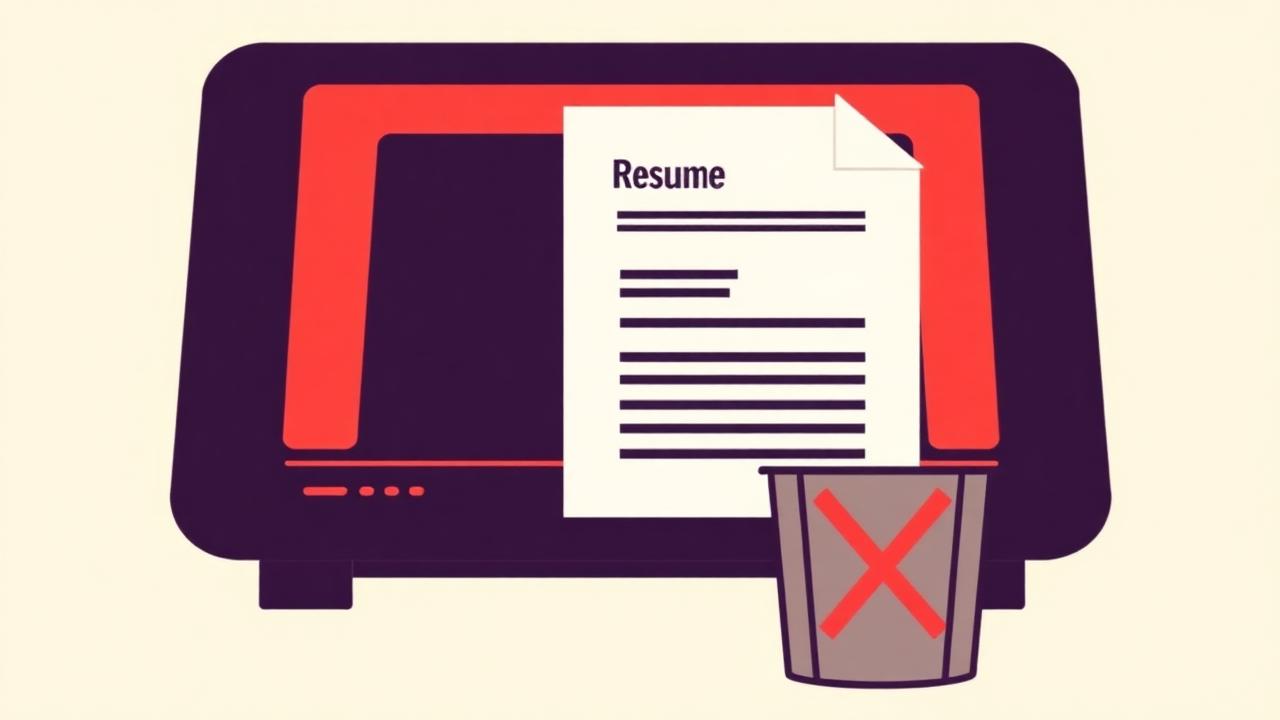
What an ATS actually does
An applicant tracking system is software that stores, organizes and searches resumes for recruiters. Two things happen to your resume when you apply: parsing (the software extracts your text into structured fields like name, skills, work history) and ranking (recruiters search or filter that database by keyword, experience, or education). A resume that parses badly can look empty or garbled to the recruiter even though it looked fine to you.
Formatting choices that break parsing
| Element | Problem | Safer alternative |
|---|---|---|
| Multi-column layout | Text can be read left-to-right across columns, scrambling sentences | Single-column layout |
| Text inside tables or text boxes | Many parsers skip content inside these entirely | Plain paragraph or bullet text |
| Headers/footers for contact info | Some parsers ignore header/footer regions | Put contact info in the main body |
| Icons instead of text labels | A phone icon isn't read as "Phone" | Use the word plus the icon, or skip icons |
| Scanned image or design-heavy PDF | No selectable text for the parser to extract | Export a text-based PDF, not an image |
Use section headers parsers actually recognize
Stick to "Experience," "Education," "Skills" and "Certifications" rather than creative alternatives. Parsers are trained on thousands of real resumes and map standard headers reliably; unusual labels increase the chance a whole section gets dropped into the wrong field or ignored.
File format and naming
File format and naming
- Save as PDF from a text-based document (not a scanned image) unless the posting requests .docx
- Name the file with your actual name — "Firstname_Lastname_Resume.pdf," not "Resume_final_v3.pdf"
- Avoid password-protecting or restricting the file — some systems can't open protected files
Using keywords without stuffing
ATS ranking usually works by matching phrases from the job description against your resume text. The fix isn't cramming keywords into a hidden white-text block (some systems can flag this as manipulation) — it's mirroring the specific terms the employer used. If the posting says "stakeholder management," don't write "worked with clients"; write "stakeholder management."
See exactly which keywords your resume is missing for a specific job description.
Check Your ATS ScoreDates, consistency, and small details
- Use a consistent date format throughout ("Jan 2024 – Present", not mixed styles)
- Spell out both the acronym and full term at least once ("Search Engine Optimization (SEO)") so both keyword forms are captured
- Avoid unusual fonts — stick to widely supported system fonts
- Keep bullet characters simple (standard round or square bullets, not custom symbols)
Test before you apply, not after you get rejected
The fastest way to know whether your formatting choices are actually parsing cleanly is to run the resume through a checker before submitting it, rather than guessing. It takes less time than the application itself and catches issues you can't see just by looking at the file.